
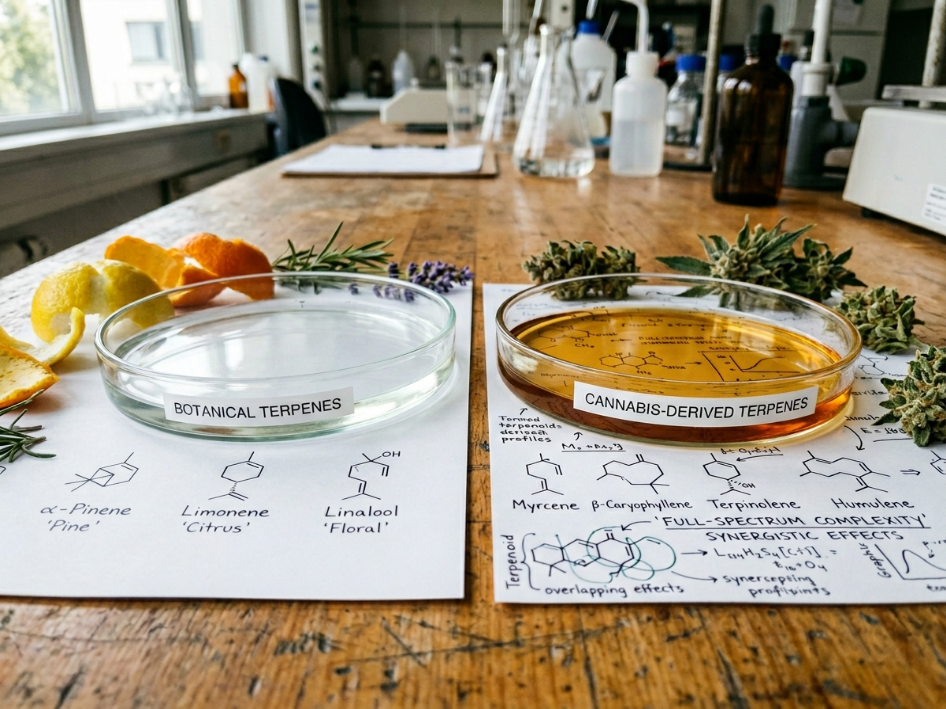
Ever stared at two terpene bottles on the shelf, one labeled "botanical terpenes," the other "cannabis-derived terpenes" (CDT), and wondered which to pick for your next formulation? You're not alone. Consumers and formulators face this "two labels, one choice" dilemma daily, especially with vaping, wellness products, and cannabis blends. Botanical terpenes come from non-cannabis plants like lavender or citrus, while cannabis-derived terpenes are extracted straight from cannabis flower, capturing its full aromatic profile.
The confusion? They look similar, but their sources, complexity, and applications differ hugely. This blog from Xtra Laboratories, your lab-verified terpene authority, breaks it down: effects, safety, legality, vaping performance, cost, and the entourage effect. We'll help you decide with science, not hype.
Quick Answer: Botanical terpenes (BDT) are chemically identical isolated molecules from plants like pine (alpha-pinene) or clove (myrcene), offering legal, scalable purity. Cannabis-derived terpenes (CDT) deliver authentic strain profiles with a full matrix of compounds for superior entourage effects, but at a higher cost and legal hurdles. Choose BDT for compliance and custom blends; CDT for premium cannabis authenticity.
What Are Terpenes and Why Do They Matter?
Terpenes are aromatic compounds produced by plants, defining everything from pine forest scents to citrus zests. In cannabis, they emerge from trichomes, those resinous glands on flowers and leaves, while in other plants, they're found in essential oils. These plant terpenes drive aroma, flavor, and therapeutic effects, influencing mood, focus, and relaxation.
Over 150 terpenes have been identified in cannabis alone, including heavy-hitters like myrcene (sedating) and limonene (uplifting). Terpene compounds aren't just sensory; they modulate cannabinoid effects via the entourage effect, enhancing bioavailability and potency. The global terpene market, fueled by wellness and food industries, hit $692 million in 2024 and is projected to reach $1.35 billion by 2033, proof of its rising demand.
At Xtra Laboratories, we use headspace GC/MS to validate these cannabis terpenes and botanicals, ensuring precision. Terpenes matter because they turn basic formulations into experiential powerhouses, whether for vaping or topicals.
What Are Botanical Terpenes? (And Where Do They Come From?)
Botanical terpenes, also called botanically derived terpenes, are terpenes extracted from non-cannabis plants, such as lavender for linalool (calming), clove for myrcene (muscle-relaxing), pine needles for alpha-pinene (alertness-boosting), or citrus peels for limonene (mood-elevating). What are botanical terpenes exactly? They're the same molecular structures as those in cannabis, 100% chemically identical at the atomic level, but sourced legally from everyday botanicals.
Extraction happens via steam distillation (gentle heat pulls volatiles), cold-pressing (for citrus oils), or supercritical CO2 (clean, solvent-free). This yields raw botanical terpenes or custom botanical terpene blends mimicking strains like OG Kush.
Key perks? They're legally available worldwide, highly scalable for mass production, and cost-effective, perfect for food, fragrance, and wellness. Most hold GRAS (Generally Recognized as Safe) status from the FDA. At Xtra Laboratories, our botanical terpene blends are lab-tested for purity, letting formulators replicate strain profiles without cannabis restrictions. No wonder they're a go-to for compliant, innovative products.
What Are Cannabis-Derived Terpenes (CDTs)?
Cannabis-derived terpenes (CDTs) are the complete essential oil pulled directly from cannabis or hemp flower, preserving the plant's full terpene matrix. Unlike isolated molecules, CDTs include minor terpenes, esters, flavonoids, and aromatic alcohols, creating strain-specific profiles like Sour Diesel's diesel-fuel punch or Blue Dream's sweet berry haze.
Extraction methods vary: live resin (flash-frozen for freshness), steam distillation, hydrocarbon (BHO for potency), or CO2 supercritical. Yields are low, only 0.5–2% from flower making production, labor-intensive, and pricey.
CDTs earn "gold standard" status for authenticity in premium cannabis products, like full-spectrum vapes or edibles. Cannabis terpenes vs. botanical terpenes? CDTs shine in strain-specific terpenes, delivering unmatched complexity. However, their cannabis origin introduces regulatory and scalability challenges. Xtra Laboratories analyzes CDTs via GC/MS to benchmark against our botanicals, highlighting why many opt for hybrids.
Botanical Terpenes vs. Cannabis-Derived Terpenes: Side-by-Side Comparison
|
Factor |
Botanical Terpenes (BDT) |
Cannabis-Derived Terpenes (CDT) |
|
Source |
Non-cannabis plants (e.g., lavender, pine) |
Cannabis/hemp flower |
|
Chemical Identity |
Identical isolated molecules |
Full terpene matrix + co-compounds |
|
Aroma Complexity |
Moderate (blended profiles) |
High (authentic strain profiles) |
|
Entourage Effect |
Partial |
Full |
|
Legal Status |
Legal worldwide |
Varies by jurisdiction |
|
Cost |
Lower ($5–15/ml) |
Higher (premium pricing) |
|
Vape Stability |
Good (up to 400°F) |
Superior (350–450°F range) |
|
Scalability |
High |
Moderate |
|
Used In |
Food, fragrance, wellness, cannabis |
Premium cannabis products |
|
Lab Testable |
Yes (GC/MS) |
Yes (GC/MS validated) |
Are Botanical Terpenes Safe to Use and Vape?
Yes, botanical terpenes are safe; most are FDA GRAS-listed for ingestion, inhalation, and topicals. But vaping safety? They offer good thermal stability, degrading minimally below 400°F, unlike some synthetics.
Look for third-party CoA with purity >95%, no residual solvents, and headspace gas chromatography terpenes botanicals method validation, our gold standard at Xtra Laboratories. We test every batch for contaminants, ensuring vape-ready botanical terpenes.
Risks arise from poor sourcing: adulterated oils or improper dilution can produce byproducts. Are botanical terpenes safe to vape? Absolutely, when lab-verified. Reddit threads echo this user's praise for clean hits from reputable BDTs. Skip untested blends; choose Xtra for peace of mind.
Botanical Terpenes Effects and Benefits: What to Expect
Botanical terpenes won't get you high, they're 100% THC/CBD-free. Do botanical terpenes get you high? No, their effects are therapeutic and sensory: linalool calms anxiety, limonene uplifts mood, myrcene relaxes muscles, pinene sharpens focus.
Benefits include precise formulation for reproducible results, ideal for wellness vapes, topicals, edibles, or aromatherapy. Botanical terpene blend effects let you target relaxation or energy without variability.
Compared to CDTs, BDTs provide cleaner, controlled effects sans full entourage amplification. Terpene therapeutic benefits shine in daily use: stress relief, better sleep, and inflammation support. Xtra's blends harness these for your formulations.
The Entourage Effect: Do Botanical Terpenes Work as Well as CDTs?
The entourage effect coined in Russo's 2011 British Journal of Pharmacology study describes how terpenes synergize with cannabinoids for amplified effects.
CDTs excel here: their full-spectrum terpenes, including minors and co-compounds, boost THC/CBD potency in cannabis products. Cannabis terpenes' entourage effect is unmatched for strain authenticity.
Botanical terpenes contribute too identical molecules enhance cannabinoids but lack the matrix for "full" synergy. Do botanical terpenes cause entourage effect? Partially, yes. Entourage effect botanical terpenes works for isolated boosts; CDT entourage effect dominates holistic cannabis.
Takeaway: CDTs for therapeutic cannabis; BDTs for legal, effects-based formulas without contraindications. Xtra Laboratories bridges this with precise blends.
Are Botanical Terpenes Legal? Legality vs. Cannabis-Derived Terpenes
Botanical terpenes are legal virtually everywhere not cannabis-derived, so no THC scrutiny. Are botanical terpenes legal? Yes, ideal for global compliance.
CDTs? A gray zone even hemp-derived (<0.3% THC) face misclassification risks. Botanical terpenes vs. CDT legality favors BDT for vapes and wellness. Hemp terpenes regulation 2025 trends toward clarity, but restrictions persist.
Brands choose botanical terpenes compliance for safety; Xtra Laboratories leads with fully documented, restriction-free options.
Botanical Terpenes vs. CDTs: Which Is Right for Your Product?
Your choice hinges on goals:
-
Choose BDT for legal compliance, scalability, cost savings, custom botanical terpene blends, or wellness/food/fragrance.
-
Choose CDT for strain-specific terpenes, max entourage, and premium cannabis positioning.
-
Choose a Blend (20–30% CDT + BDT) for affordable authenticity.
Cannabis-derived terpenes vs. botanical terpenes: which is better? Depends on use. CDT vs. BDT: BDT wins versatility. Xtra Laboratories offers botanical terpenes for sale, including sample kits. Explore our botanical terpene blends or order a terpene sample kit today.
Final Thoughts: Making the Right Terpene Choice
Botanical terpenes offer purity and compliance; CDTs bring cannabis authenticity. Pick based on goals, budget, and regs BDT for innovation, CDT for tradition.
Xtra Laboratories delivers high-purity, GC/MS-verified botanical terpenes. Shop botanical terpenes for sale, grab a terpene sample kit, or contact us for wholesale botanical terpenes.
Frequently Asked Questions About Botanical Terpenes
What are botanical terpenes?
Botanical terpenes are aromatic compounds extracted from non-cannabis plants, such as citrus peels for limonene (uplifting citrus notes) or lavender for linalool (calming floral aroma). Chemically identical to those in cannabis at the molecular level, what are botanical terpenes used for? They're ideal for legal, scalable vaping, wellness products, and custom blends, offering purity without regulatory hurdles. Xtra Laboratories provides lab-tested raw botanical terpenes for precise formulation.
What is the difference between botanical terpenes and cannabis-derived terpenes?
Botanical terpenes (BDT) are isolated from plants like pine or clove, providing cost-effective, worldwide-legal options with blended profiles. Cannabis-derived terpenes (CDT) capture the full cannabis flower matrix, including minor compounds for authentic strain flavors like Sour Diesel. Botanical terpenes vs CDT differ in complexity: BDT for compliance and custom effects; CDT for premium entourage synergy, though pricier and jurisdiction-limited. Choose based on your product's needs.
Do botanical terpenes get you high?
No, botanical terpenes contain zero THC or CBD, so they won't produce psychoactive effects. Their power lies in sensory and therapeutic benefits like myrcene for relaxation or pinene for focus via aroma and targeted blending. Perfect for wellness vapes or topicals, they enhance mood without intoxication. Xtra's botanical terpene blends deliver consistent, non-high results every time.
Are botanical terpenes safe to vape?
Yes, most botanical terpenes are FDA GRAS-listed for inhalation when pure. Are botanical terpenes safe to vape? They offer good thermal stability up to 400°F with minimal degradation verify via third-party CoA and headspace GC/MS testing for >95% purity and no solvents. At Xtra Laboratories, every batch undergoes rigorous terpene CoA testing to ensure vape-safe botanical terpenes, addressing Reddit concerns about quality.
What does "botanically derived terpenes" mean?
"Botanically derived terpenes" (or botanical derived terpenes) refers to terpenes extracted from non-cannabis sources using methods like steam distillation, cold-pressing, or CO2 yielding pure, identical molecules to cannabis ones. What is botanical derived terpenes best for? Legal compliance, food-grade applications, and scalable blends without THC risks. Xtra Laboratories specializes in these for fragrance, edibles, and vapes.
Are botanical terpenes as effective as CDTs for the entourage effect?
Partially botanical terpenes' molecules match CDTs for synergy with cannabinoids, but lack the full cannabis matrix of minors and flavonoids for complete entourage effect (per Russo 2011). Cannabis-derived terpenes entourage effect is superior for strain authenticity; botanical terpenes excel in controlled, legal formulations. Xtra blends optimize partial entourage for wellness without full-spectrum complexity.



Share:
Elevate Your Experience with Xtra Laboratories' Botanical Terpene Flavored Products
Discover the Surprising Benefits of Cannabis Terpenes - What You Need to Know