
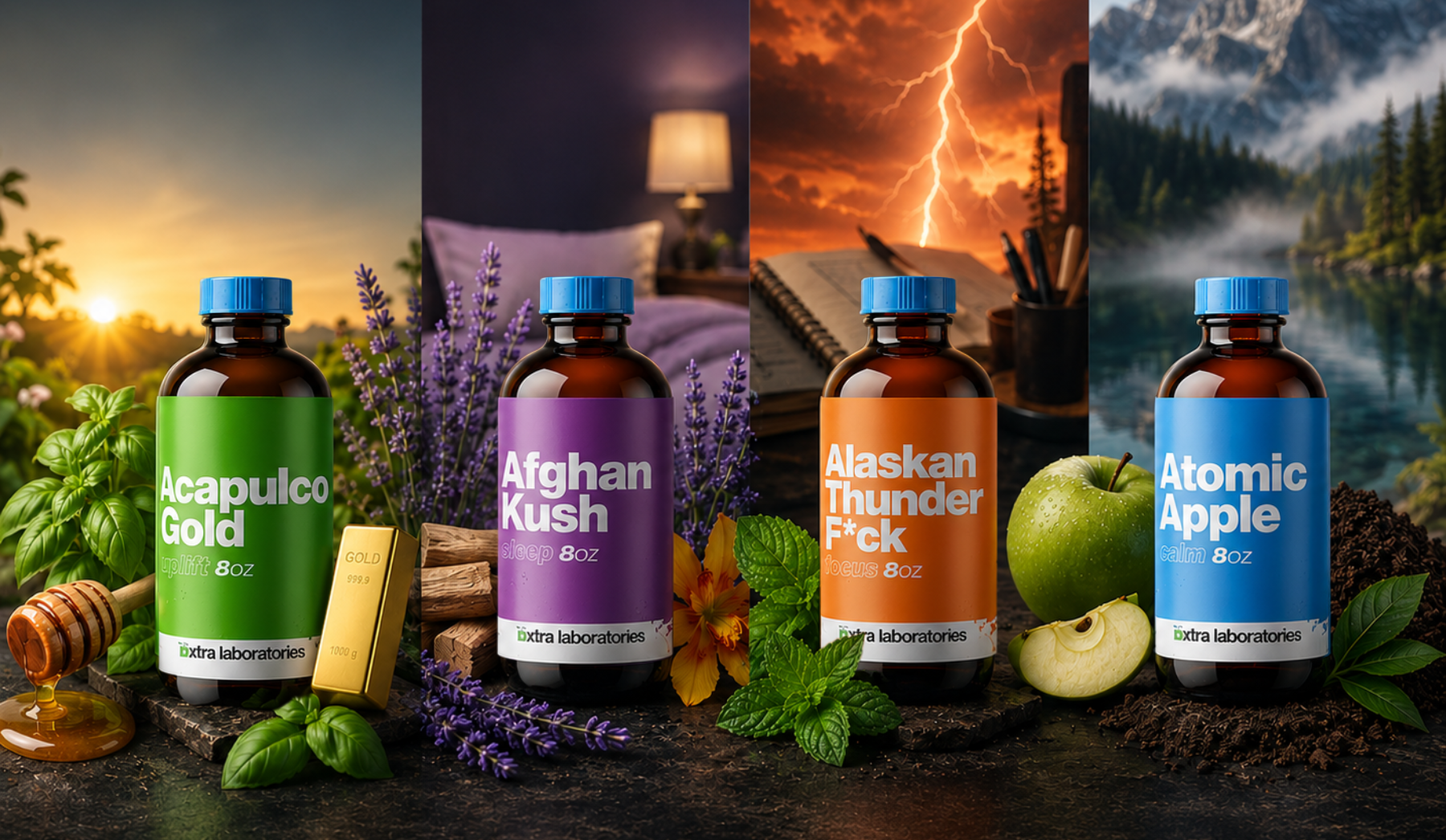

What are terpenes?
Terpenes are naturally occurring aromatic compounds found in cannabis and thousands of other plants, responsible for the distinctive scent, flavor, and character of each strain or cultivar. They are a core tool for cannabis formulators because they shape aroma, taste, and the perceived “feel” of products when combined with cannabinoids.
You can work with terpenes in several forms:
- Single terpene isolates (like limonene, myrcene, linalool)
- Blended “strain-type” profiles that mimic popular genetics
- Full‑spectrum extracts that carry a broader plant‑like fingerprint
- Botanical sources (from non‑cannabis plants) or cannabis‑derived terpenes (CDT)
In formulation, terpenes are used not only to recreate strain profiles but also to design functional experiences: calm vs uplift, day vs night, flavor‑first vs effects‑first products.
Are terpenes legal?
Terpenes themselves are widely legal because they are found throughout nature and are already used in food flavoring, cosmetics, perfumes, household products, and aromatherapy. Botanical terpenes (those sourced from non‑cannabis plants) contain no THC, no CBD, and no scheduled substances, which keeps them federally compliant in the U.S. and acceptable in most global markets.
Cannabis‑derived terpenes (CDT) are a different regulatory story. Because they are extracted directly from cannabis, they can sometimes contain trace cannabinoids that push them into cannabis or hemp regulations in certain jurisdictions. Always:
- Verify state or country‑specific rules before adding CDT to any product line
- Keep certificates of analysis (COAs) on file to show cannabinoid content
- Coordinate with your compliance officer or legal partner before launch
Botanical terpenes are typically the go‑to choice for SKUs that must ship across state lines or borders, while CDT is often reserved for premium, in‑market products where cannabis licensing is already in place.
Safety rules: never use terpenes undiluted
Terpenes are extremely concentrated and must always be diluted before they go anywhere near a consumer’s lungs, mouth, or skin. Treat them more like strong chemicals than like gentle essential oils.
Core safety principles:
- Never consume, inhale, or apply undiluted terpenes directly to skin
- Always dilute into a compatible carrier: oil, distillate, wax, balm base, etc.
- Start at the lowest effective concentration and increase slowly with testing
- Keep terpene containers away from children, pets, and untrained staff
- Store in sealed amber glass bottles in a cool, dark environment
- Remember that terpenes are flammable: keep away from open flame, hot coils, and sparks
For lab and manufacturing environments, include terpenes in your standard safety training, PPE protocols (gloves, goggles, good ventilation), and spill procedures.
How to use terpenes in vapes & distillate
Vape and distillate formulations are where terpene percentages matter most, because ratios directly affect flavor, viscosity, throat hit, and hardware performance. The updated safe‑use guide narrows in on a lower, more controlled range than older industry norms.
Updated concentration ranges
Overall working range for vapes and distillate:
- General: 1–5% terpene concentration by weight
- Practical sweet spot for most distillate vapes: 2–3%
- Suggested targets by hardware type:
- Ceramic cell cartridges: 3–5%
- Cotton wick cartridges: 2–4%
- All‑in‑one (AIO) disposables: 2–3%
- General distillate (non‑hardware‑specific): 2–3%
Staying in this range helps avoid harshness, coil flooding, overly thin oil, and terpene‑related irritation. Older recommendations that pushed up to 10% are now considered excessive for most applications.
Step‑by‑step process
-
Gently warm the distillate
- Use a low‑heat plate or warm water bath.
- Avoid direct contact with flames or high‑temperature surfaces.
-
Measure terpenes precisely
- Use a digital scale with at least 0.01 g accuracy.
- Weigh by percentage of the total batch (for example, 2–3% of total mass).
-
Add terpenes slowly
- Introduce drop by drop into the warm distillate, never all at once.
- This helps prevent localized over‑concentration and separation.
-
Mix thoroughly
- Stir slowly using glass or stainless steel tools.
- Continue until the solution appears visually uniform and clear.
-
Test before scaling
- Fill a test cartridge.
- Allow 1–2 hours to steep so the terpene–distillate mixture equilibrates.
- Perform sensory and hardware testing before running full batches.
Use a terpene calculator to quickly derive batch weights and keep a record of hardware‑specific formulas, especially useful when you’re running different SKUs across multiple cartridge types.
How to use terpenes in edibles & gummies
Terpenes are fat‑soluble, so they integrate best into the fat or oil portion of an edible formulation. Because they are volatile, timing and temperature matter: heat can easily drive off aroma and reduce both flavor and perceived effect.
Updated concentration range for edibles
-
General terpene range in fat/oil phase: 0.1–0.5% by weight
This updated range is significantly lower than older 0.5–1.5% norms and better aligned with flavor balance and safety guidance. Working at 0.1–0.5% usually avoids overpowering taste and irritation while still providing a distinct terpene signature.
Application guidelines
-
Gummies and hard candies
- Infuse terpenes into the fat or oil component used to carry flavors.
- Target 0.1–0.5% of the fat/oil weight, adjusting based on flavor intensity.
-
Chocolates and baked goods
- Blend terpenes into cocoa butter, coconut oil, ghee, or another fat source.
- Stay within 0.1–0.5% relative to the fat phase; richer bases often need less.
-
Tinctures and sublingual oils
- Mix terpenes into MCT, hemp seed oil, or other carrier oils.
- Begin at 0.1–0.5% and increase only if flavor and sensory testing indicate room for more.
Always add terpenes as the mixture cools, not during high‑heat cooking phases. For example, stir them in once the melted chocolate or syrup is below high‑evaporation temperatures to preserve the aromatic profile. Fruit‑forward and fusion terpene blends tend to shine in edibles, pairing naturally with sweet or sour flavor systems.
How to use terpenes in concentrates
During many extraction processes, native terpenes are stripped out or significantly reduced, leaving concentrates potent but flat in aroma and taste. Carefully reintroducing terpenes lets you restore or customize the sensory experience, but restraint is essential.
Best practices
-
Warm gently
- Slightly warm wax, shatter, or distillate until it becomes workable, never scorching.
-
Dose low and slow
- Add terpenes with a glass pipette, drop by drop.
- Mix and smell after each small addition rather than jumping straight to your maximum percentage.
-
Typical ranges by concentrate type
- Wax and shatter: 1–3% by weight
- Rosin and live resin: 0.5–1% (these products are already terpene‑rich, so this is for enhancement only)
- Distillate‑based concentrates: up to 5%, with most products performing well closer to 2–3%
Fold or stir gently to incorporate, then allow the concentrate to cool completely before final aroma assessment. The nose you get at mixing temperature is often different from what the consumer will experience at room temperature.
How to use terpenes in topicals & personal care
For topicals, skin safety is the primary concern. Terpenes can be skin‑sensitizing at high levels, and the updated guide is much stricter about maximum concentrations. These lower ranges still deliver noticeable aroma and potential functional benefits while staying on the safer side of dermal exposure.
Updated topical concentration range
- General range: 0.25–0.5% by weight in the finished product
- Hard rule: never exceed 0.5% total terpenes in any leave‑on topical
This ceiling is directly tied to minimizing risk of skin irritation and burn‑like reactions, especially for sensitive users or repeated application.
Application guidelines
-
Lotions, creams, balms, hair products
- Mix terpenes into the finished base or into the oil phase before the final emulsion.
- Keep total terpene load between 0.25% and 0.5%.
-
Targeted applications (temples, joints, pulse points)
- Dilute a single drop of terpene or terpene blend into an appropriate carrier oil (jojoba, sweet almond, coconut, or a finished balm).
- Ensure that the final terpene percentage is still under 0.5%.
-
Popular terpene choices for topicals
- Myrcene: earthy, often associated with relaxing, heavy “body” character
- Linalool: floral, commonly linked to calming and spa‑like profiles
- Limonene: citrusy, perceived as bright and mood‑lifting
Always patch test new formulations on a small area of skin before wider use or commercial release. Build your topical line with botanical terpene isolates for consistency and easier regulatory positioning.
How to use terpenes in aromatherapy & diffusers
For aromatherapy, candles, and bath products, terpenes function similarly to very strong essential oils, highly aromatic and potent at low doses. Because of their volatility and flammability, application methods and percentages matter.
Application tips
-
Ultrasonic diffusers
- Add 3–5 drops of terpene blend to the water reservoir.
- Use in a well‑ventilated room and avoid running continuously for long periods.
-
Candles
- Add terpenes at pour point (typically 140–150°F, depending on wax type).
- Use 3–6% of total wax weight, ensuring flash points are respected and testing for hot and cold throw.
-
Bath salts and bath bombs
- Blend terpenes at 0.5–1.5% of total formula weight, ensuring good dispersion.
- Combine with carrier oils or solubilizers for more even distribution in water.
Calming terpene profiles (myrcene, linalool) are suitable for evening, unwind‑focused products, while more uplifting profiles (limonene, pinene) are ideal for daytime or “focus/energy” positioning. Always follow standard candle and diffuser safety practices, including burn time limits and ventilation.
How to use terpenes to cure & enhance flower
Terpene enhancement for flower must be done carefully. The updated guide removes any suggestion to apply raw terpenes directly to flower, because that can easily lead to hot spots, harshness, and unsafe exposure. Instead, terpenes should always be introduced via a carrier.
Updated method and concentration
- Use 0.1–0.5% terpenes by weight of flower
- Always blend terpenes into a carrier (such as a neutral concentrate or light oil) before they come into contact with the flower
- Never drip raw, undiluted terpenes directly onto flower
Practical approach
-
Prepare a terpene–carrier blend
- Mix your terpene profile into a compatible concentrate (distillate, neutral extract, or light oil) at a low concentration.
- Ensure the resulting mixture is easy to distribute lightly.
-
Introduce to flower
- Lightly coat or mist the carrier blend over the flower, or place the terpene‑infused carrier in the curing container to allow gradual absorption.
- Alternatively, keep a terpene‑carrier source inside a sealed curing container so the flower absorbs aroma over several days without physical saturation.
-
Monitor character
- Check aroma daily during curing or enhancement.
- Adjust exposure time and concentration in small increments rather than chasing big jumps.
Full‑spectrum and CDT profiles generally provide the most “authentic” strain‑like enhancement, while botanical blends can be tuned for consistent, repeatable flavor lines across large volumes.
How to use terpenes in beverages
Because terpenes are oil‑based and not naturally water‑soluble, they need support ingredients or specialized processes to behave well in beverages. Without an emulsifier, terpenes will float, cling to packaging, and create inconsistent dosing.
Key considerations
-
Water‑based beverages
- Terpenes do not mix into water by themselves.
- Use food‑grade emulsifiers (such as lecithin or commercial beverage emulsions) or nano‑emulsification systems to create a stable, clear beverage.
-
Fat‑containing beverages
- Terpenes blend more easily into milk‑based drinks, smoothies, lassis, and other dairy or fat‑containing formats.
- Integrate terpenes into the fat portion first, then disperse.
Concentration range
- Start at 0.1–0.5% terpenes in the beverage system, depending on how strong you want the aroma and flavor.
- Begin at the low end and adjust upward only after sensory and stability testing.
Fruit and fusion terpene profiles often translate best to beverages since they tie naturally into citrus, tropical, berry, and herbal flavor concepts. For more advanced work (especially canned, shelf‑stable drinks), collaborate with beverage formulators who specialize in cannabis or functional ingredients and can help with emulsion design.
Terpene dosage reference chart
Below is a quick reference chart reflecting the updated guidance:
|
Application |
Typical Terpene Range (by weight) |
|
Vape cartridges (ceramic) |
3–5% |
|
Vape cartridges (cotton wick) |
2–4% |
|
Disposable vapes (AIO) |
2–3% |
|
General distillate |
2–3% (overall 1–5% working range) |
|
Cannabis concentrates |
1–3% (up to 5% for some distillate blends) |
|
Cannabis flower |
0.1–0.5% (via carrier, never raw) |
|
Edibles (fat/oil base) |
0.1–0.5% |
|
Tinctures/sublingual oils |
0.1–0.5% |
|
Topicals/balms |
0.25–0.5% (never exceed 0.5%) |
|
Candles |
3–6% of wax weight |
|
Diffusers |
3–5 drops in the water reservoir |
|
Beverages (emulsified) |
0.1–0.5% |
Always start at the bottom of the range, run small‑batch tests, and move up only if your sensory results and safety considerations allow it.
Botanical vs. cannabis‑derived terpenes: which to use?
Your choice between botanical terpenes and cannabis‑derived terpenes (CDT) should follow your brand positioning, target markets, and regulatory environment.
Botanical terpenes
- Sourced from non‑cannabis plants (citrus, pine, lavender, spices, etc.)
- Blended to mimic specific strains or to create custom flavor/effect profiles
- Typically lower cost and easier to source at scale
- Highly attractive for SKUs that need broad regulatory compliance and consistent supply
Cannabis‑derived terpenes (CDT)
- Extracted directly from cannabis or hemp plant material
- Capture a “true‑to‑plant” aromatic matrix, including many minor terpenes and other volatiles
- Ideal for premium products, connoisseur audiences, and “authentic strain” storytelling
- Must fit within cannabis/hemp regulations, often limited to licensed markets
Many brands use both: botanical terpenes for large‑scale, widely distributed products; CDT for flagship or premium lines where authenticity and strain specificity are the main selling points. Testing both styles in small runs is the best way to see what resonates with your consumers and fits your cost structure.
Storage and shelf life
Good storage practices protect your terpene investment and keep profiles consistent over time. Terpenes are sensitive to light, heat, and oxygen.
Best practices:
- Store in sealed amber glass bottles to reduce light exposure
- Keep in a cool, dark place, away from direct sunlight and heat sources
- Avoid repeated opening and long “open‑air” handling; decant smaller working volumes if needed
Refrigeration can be used for long‑term storage, but be aware it may thicken oil‑soluble terpene blends. Let chilled products come back to room temperature gradually before use, and mix gently to re‑homogenize if needed.
Typical shelf‑life guidance (assuming proper storage):
- Pure terpene isolates: often up to 24 months
- Blended profiles: commonly around 12–18 months
- Always check aroma, clarity, and COAs and follow supplier recommendations
If a terpene product smells “off,” shows unexpected cloudiness, or no longer matches its specification, pull it from production and consult the supplier before use.
Shop terpene profiles and support
For formulators, the ideal terpene partner offers both variety and repeatability. Look for suppliers that provide:
- A wide library of profiles (botanical, CDT, full‑spectrum, fruit, and fusion)
- ISO and GMP‑certified manufacturing for consistent batch‑to‑batch quality
- Third‑party COAs for every batch
- Flexible order sizes from small R&D volumes (for example, 1–5 ml bottles) to wholesale quantities
- Technical support on application, dosage, and regulatory concerns
Sample packs are particularly useful for development: you can rapidly screen multiple profiles, create A/B/C versions of your formulas, and align internal teams on flavor and effect directions before committing to larger orders.
Frequently Asked Questions
No. Terpenes should never be used undiluted. They are highly concentrated and can be harsh, irritating, or even damaging if inhaled, ingested, or applied to skin in pure form.
Always dilute terpenes into a compatible carrier distillate, oil, wax, balm, candle wax, emulsified beverage base at the safe percentage ranges listed in this guide. If you’re ever unsure whether a form of use is safe, treat that as a sign to reduce concentration and seek technical support before moving forward.
For distillate-based vape products, stay in the updated 1–5% range, with 2–3% as the most common sweet spot for both flavor and smoothness.
Refined by hardware type:
- Ceramic cell cartridges: 3–5%
- Cotton wick cartridges: 2–4%
- AIO disposables: 2–3%
- General distillate: 2–3%
Always run R&D batches first and test across multiple puffs, not just a single hit. A formula that seems fine at first can feel harsh or cloying over a full session if terpene content is too high.
Botanical terpenes do not produce a cannabis-style “high” on their own. They contain no THC or CBD and do not activate cannabinoid receptors in the same way.
However, terpenes are believed to modulate the effects of cannabinoids through the so-called entourage effect, influencing how a consumer experiences a product when terpenes and cannabinoids are combined. This modulation is more about shaping the experience (uplifting, relaxing, clear-headed) than directly creating intoxication.
Neither botanical terpenes nor cannabis-derived terpenes are universally “better”; they simply serve different strategic purposes.
Choose botanical when you need:
- Lower cost per unit
- Scalable, consistent supply
- SKUs that must stay compliant across many regions
- Highly creative or non-traditional flavor profiles
Choose CDT when you want:
- “True-to-plant” authenticity
- Strain-specific storytelling and connoisseur appeal
- Premium positioning in licensed markets
Some of the strongest portfolios use both, assigning each type to the product category where it makes the most sense.
Store terpenes in sealed amber glass bottles, in a cool, dark place away from heat and direct sunlight. Limit how often you open your main stock bottle by decanting smaller working volumes for daily use.
Refrigeration is acceptable for long-term storage, but it can cause oil-soluble blends to thicken or become sluggish. If you refrigerate, allow the bottle to warm back to room temperature and mix gently before use. Pay attention to supplier shelf-life guidance (commonly 12–24 months) and evaluate aroma and clarity periodically.
A basic terpene formulation setup includes:
- Digital scale with 0.01 g precision or better
- Glass syringes or pipettes for accurate dosing
- Glass beakers or mixing containers
- Glass or stainless-steel stirrers
- Temperature-controlled hot plate or warm-water bath for gentle heating
- PPE: gloves, eye protection, and good ventilation
As your operation scales, you may also add magnetic stirrers, overhead mixers, filling machines, and dedicated ventilation systems. The core principle is control: precise measurement, consistent mixing, and repeatable processing temperatures.
No. Beyond a certain point, more terpenes often mean harsher, more irritating products rather than better flavor. High terpene loads can create throat hit, chemical-like notes, and skin sensitivity in topicals.
Most successful vapes and edibles sit comfortably in the low-to-middle ranges in this guide, where flavor is expressive but not overwhelming. Use your nose, your palate, and structured sensory sessions, not just maximum percentages, to guide your formulas.
For commercial brands and licensed operators, most advanced terpene suppliers provide wholesale pricing tiers, bulk packaging options, and custom formulation services. These services usually include:
- Custom flavor and strain profile design
- Matching or recreating existing profiles from benchmarks
- Bulk pricing for liters or larger volumes
- Technical consultation on dosage, applications, and stability
If you are scaling from small-batch to regional or national distribution, partnering with a supplier that can grow with your volume and assist with documentation (COAs, spec sheets, safety information) is key.
Ready to formulate with premium terpenes?
Whether you’re building a vape lineup, launching a terpene‑forward gummy range, enhancing concentrates, or crafting signature topicals, the principles are the same: respect concentration limits, start low, and test relentlessly before scaling. With the updated ranges and safety rules in this guide, you can move confidently from idea to production while protecting both your consumers and your brand.
Share:
Limonene Terpene Effects: Citrus Aroma, Cannabis Profiles, and Botanical Applications
Which Terpenes Help With Sleep? Top Sleep Terpenes for 2026